
May 23, 2025
Aliados achieved significant milestones in 2024 thanks to the collaboration of more than 50 partners in initiatives related to recycling, water conservation, neighborhood business empowerment, youth employability, and sports development. In 2025, the platform integrated new organizations and plans to scale up its work through the use of artificial intelligence.
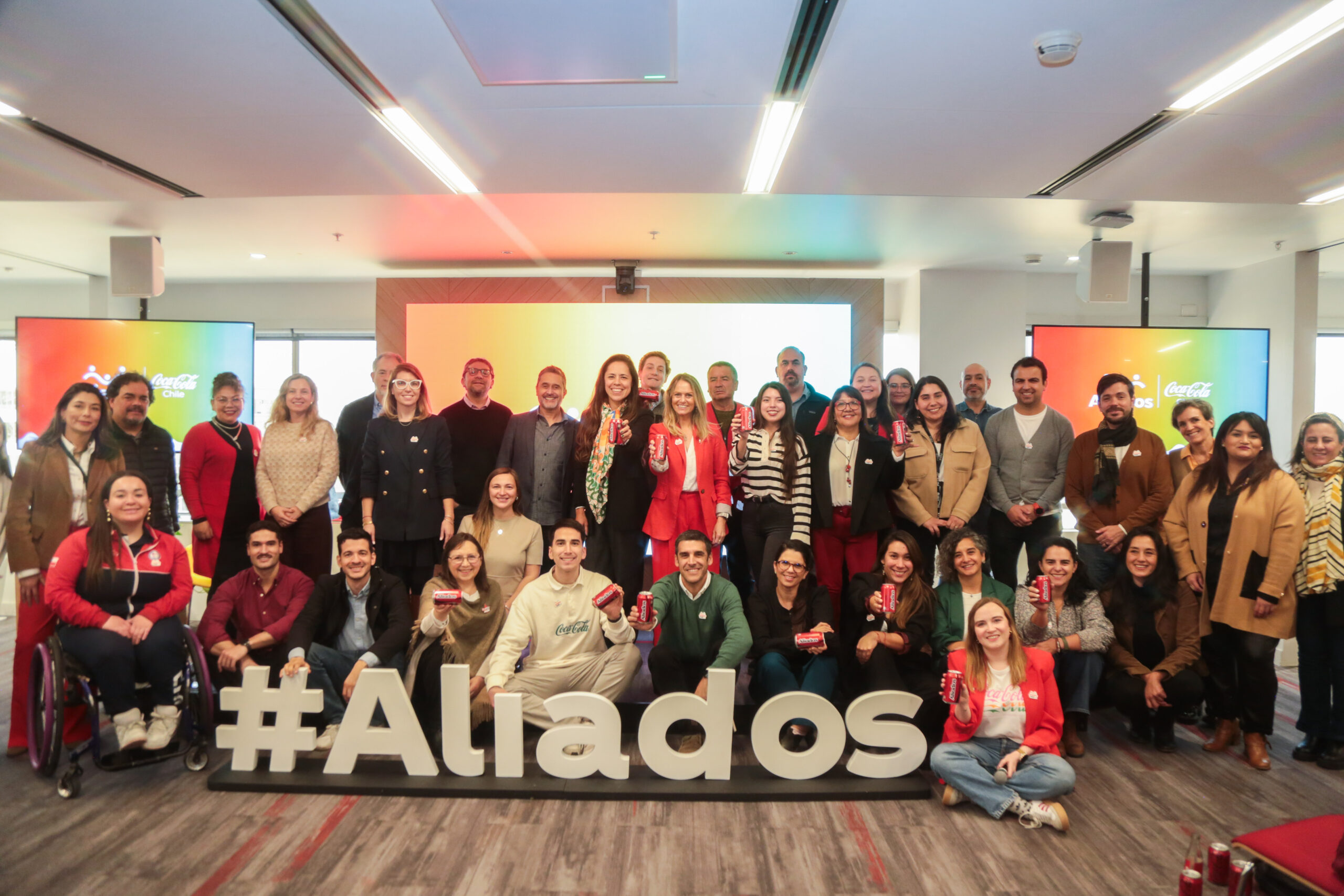
Collaboration, partnerships, teamwork, innovation, sustainability, and the use of artificial intelligence marked the celebration of the first anniversary of Aliados, the collective action platform promoted by Coca-Cola Chile, which gives identity and frames the way to implement key initiatives such as recycling, water conservation, neighborhood business empowerment, youth employability, and sports development.
At the ceremony, held on Thursday, May 15, at the company’s corporate headquarters, the achievements made in 2024 thanks to the collaboration of 50 partner organizations were first announced, including: delivery of professional equipment to 12 grassroots recycling cooperatives for their professionalization and development; the inauguration of the Re-Ciclar plant, a modern PET beverage bottle recycling plant operated by Coca-Cola Andina and Coca-Cola Embonor for the reuse of disposable plastic containers.
La colaboración, las alianzas, el trabajo en equipo, la innovación, la sostenibilidad y el uso de la inteligencia artificial marcaron la celebración del primer aniversario de Aliados, la plataforma de acción colectiva promovida por Coca-Cola Chile, que da identidad y enmarca la forma de implementar iniciativas clave como el reciclaje, la conservación del agua, el empoderamiento empresarial de los barrios, la empleabilidad de los jóvenes y el desarrollo deportivo.
En la ceremonia, celebrada el jueves 15 de mayo en la sede corporativa de la empresa, se dieron a conocer los logros alcanzados en 2024 gracias a la colaboración de 50 organizaciones asociadas, entre los que se incluyen: la entrega de equipamiento profesional a 12 cooperativas de reciclaje de base para su profesionalización y desarrollo; la inauguración de la planta Re-Ciclar, una moderna planta de reciclaje de botellas de PET para bebidas operada por Coca-Cola Andina y Coca-Cola Embonor para la reutilización de envases plásticos desechables.
On this occasion, Paola Calorio, Director of Public Affairs, Communications, and Sustainability at Coca-Cola Chile, said, “We are very proud and satisfied because we have just completed one year of Aliados, which seeks to bring together knowledge and all collaborative projects on a single platform to achieve connection, influence, and greater impact. We have seen that this generates wonderful collaboration and incredible results. For Coca-Cola Chile, this first anniversary means putting on the agenda and highlighting the importance of meaningful collaboration. Coca-Cola seeks to refresh the world, but not just in any way, but in a positive way in the communities where we are, and we cannot achieve this alone, but with allies and collaboration.”
New companies and organizations that joined Aliados this year were also presented, including the startup Kran, which uses nanobubble technology to treat water; the Technology Transfer Group Foundation (GTT), based on deep collaboration between farmers to improve their processes; País Circular, the information platform on environmental advances and challenges, whose founders include Pablo Badenier, former Minister of the Environment; the Chilean Gastronomy Association (Achiga), which brings together and represents the national gastronomy industry; and the startup Redciclach, a platform that encourages the virtualization of returnable bottles.
Aliados 2025 and Artificial Intelligence
The event was also marked by a profound reflection on how the use of artificial intelligence (AI) can further expand the scope and results of the Aliados platform in 2025, in order to integrate technologies to enhance collaborative work, incorporating them across each project, optimizing processes, and accelerating the implementation of sustainable solutions in a more efficient and scalable manner.
In this regard, Julio Rojas, film and series screenwriter, science fiction writer, known for the podcast Caso 63, gave a talk entitled “The unthinkable decade: artificial intelligence, disruption, and sustainability,” in which he reviewed the history of this new technology that is revolutionizing the world and shared his vision on how to use it for projects such as those promoted by Aliados. “The key is regenerative sustainability, where artificial intelligence becomes another piece of this puzzle, of this beautiful project that is Aliados, to facilitate the work of the participating organizations, increase collaboration among all, and thus achieve results that impact people and the planet,” said the author.
Next, a panel discussion entitled “The future is also sustainable: can artificial intelligence take care of the planet?” was held, with the participation of María Francisca Yáñez, business director and AI expert; Guido Girardi, former senator and founder of the Congress of the Future; Antonia Moreno, head of Studies and Public Advocacy at the National Center for Artificial Intelligence (CENIA); and Andrea Ramos, leader of Climate Adaptation at Kilimo for Latin America.
María Francisca Yáñez stated that “I consider artificial intelligence to be vitally important, because in an era of so much change and speed as we are experiencing today with AI, applying it to Aliados really adds value to this platform through collaboration. For me, this is the basis of any successful project.”
Meanwhile, Guido Girardi argued that “artificial intelligence has enormous opportunities in health, security, and sustainability. But it also poses a profound ethical dilemma: we can choose between remaining human or moving toward a posthuman reality,” said Guido Girardi, former senator and creator of Congreso Futuro.
Antonia Moreno, in turn, gave an example of how AI can help make the planet a better place with the Guacamaya project, which is being implemented in the Amazon using an AI platform to monitor the integrity of the region’s flora and fauna, which is vital to humanity due to its biodiversity and rich vegetation. “What AI allows us to do is analyze a large volume of data in real time, which we could not do otherwise, and therefore take timely action. This technology can extend human capabilities, allowing us to devote ourselves to other things, to strategy, expanding work possibilities, and that is very positive.”
Andrea Ramos, in turn, pointed out that “what we have learned at Kilimo working with the Aliados platform is that radical collaboration is required, such as the one we have with the Nilus company, where they were dedicated to increasing water in the mountains and we were dedicated to helping manage it in the basin with farmers. That is why we applied and worked together. The problem today is that we are in a challenging and changing global scenario, there are budget cuts in the areas of sustainability, and that is why it is necessary to use data and technology to obtain and defend the results we are achieving with our projects.”
SOURCE: latercera