
June 11, 2025
Representatives from more than 70 institutions participated in the first Territorial Meeting of the Regional Network for Learning, which seeks to motivate students and reverse the educational crisis in the area.
With a cross-cutting call for participation and more than 100 attendees, the first Territorial Meeting of the Regional Network for Learning marked a milestone in the coordination of efforts between companies, foundations, trade associations, municipalities, and educational entities. The event, held at the Hotel Cabaña del Lago in Puerto Varas, was organized by Enseña Chile with the support of SalmonChile and the Salmon Council. Its objective was clear: to build a shared vision and effective strategies to address the learning crisis affecting thousands of students in the Los Lagos Region.
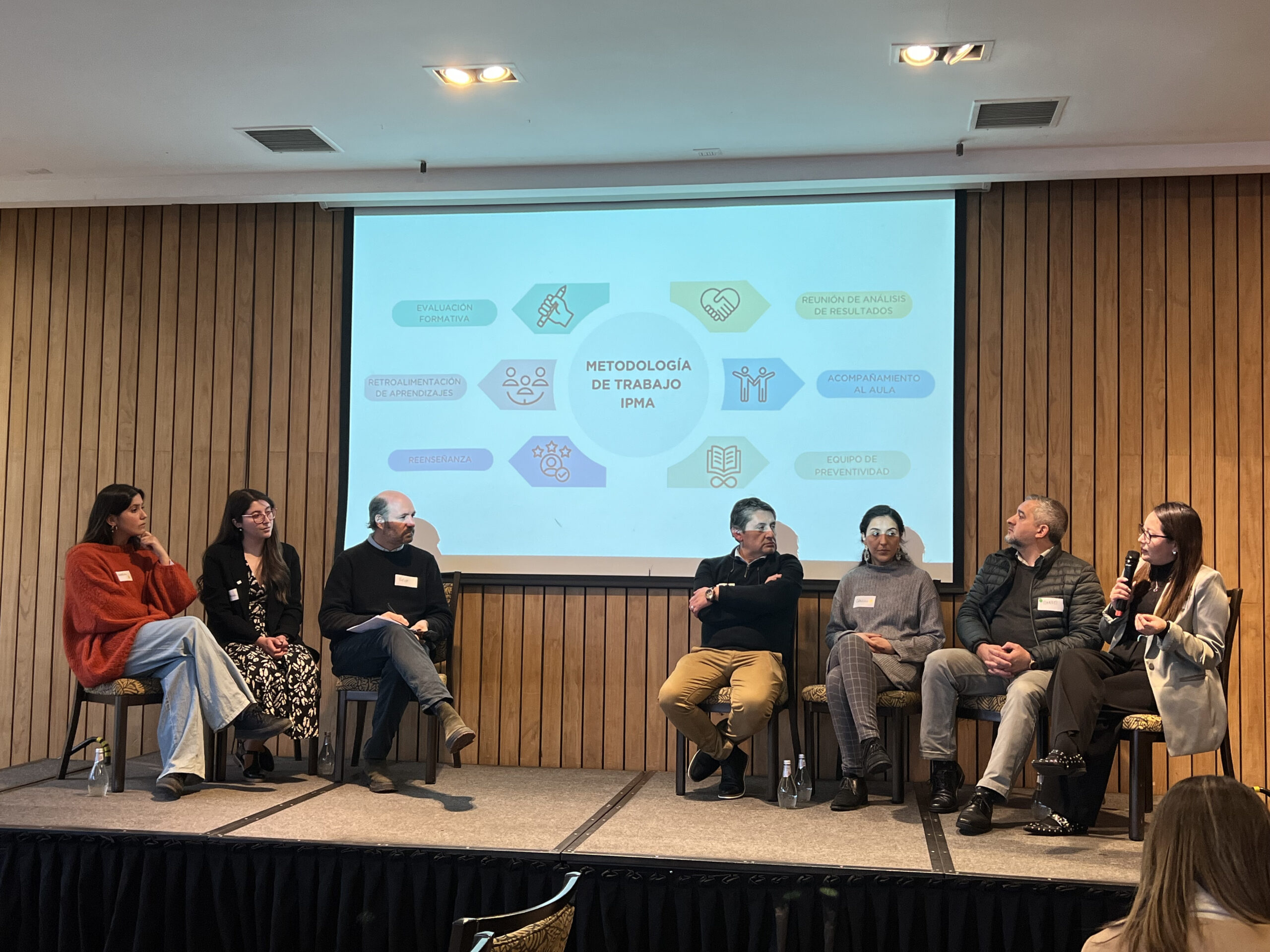
The day began with a presentation by Vicente Gutiérrez, director of Data Educa, who highlighted the magnitude of the problem, emphasizing chronic absenteeism, learning gaps, and low student motivation. In response to this diagnosis, regional experiences of impact were presented in a panel discussion with the participation of representatives from the María Auxiliadora Polytechnic Institute, the United Nations Technical School, the Aprender Project, and the NGOs Canales and Kran. This was followed by a networking session aimed at linking skills and resources with the specific needs of educational establishments, ranging from preschool to higher education.
Felipe Díaz, director of Communities at SalmonChile and member of the Network’s Strategic Council, explained that the data provided by Data Educa marked a turning point. “When we started a year ago, we were shocked to see the actual figures for children and young people who are not learning. It was a reality check. Although there was a lot of effort from companies, the government, and foundations, when we looked at the indicators, we realized that learning was not progressing. And we couldn’t let that go.”
For this reason, SalmonChile called on its member companies to join in with their own educational strategies. “We asked them to share what they were already doing in their communities. Many joined enthusiastically, sharing their initiatives and linking up with other foundations to enhance what works. This network becomes a platform for horizontal collaboration, where we all contribute with what we know and have. This model should not only be consolidated in Los Lagos, but also scaled up to other regions such as Aysén, Magallanes, La Araucanía, and Biobío, because learning is a national problem,” said Díaz.
Likewise, the director of Communities at SalmonChile emphasized that the role of companies is not limited to financing projects or providing resources, but also involves active participation in the territories. “Often, the technical teams of salmon farming companies participate directly in educational processes, teaching classes, taking students to visit processing plants or farming centers, and explaining the salmon cycle or what aquaculture production entails in the field. This creates a genuine connection between students and the industry, allowing children to envision a concrete future career with real opportunities for development.”
Regional network
Currently, the Regional Learning Network brings together 70 institutions, including AquaChile, Badinotti Group, Caleta Bay, Cecinas Llanquihue, Consejo del Salmón, Enseña Chile, Fundación Colbún, Hotel Cabaña del Lago, Kran, Manuka, Multi X, SalmonChile, Salmones Austral, Association of Municipalities of the Province of Llanquihue, Codesser, Fundación 99, Astoreca, Brotario, Fundación CAI, Compás Sur, Fundación Empre+, Fundación Familias Primero, Fundación Legado Chile, Fundación Mapa, Fundación MC, Fundación Mustakis, Fundación Parque Katalapi, Patio Vivo, Fundación Presente, Fundación Ulmo, Instituto de Investigaciones Agropecuarias (INIA), Kodea Foundation, Music Together Lago Llanquihue, NGO Canales, NGO Kalfutray, Aprender Project, Volando en V Foundation. And the support of the Education Quality Agency, the Llanquihue Local Public Education Service, the Los Lagos Regional Government, the Municipality of Puerto Varas, and the Municipality of Puerto Montt, among many others.
From a complementary trade association perspective, Alejandra Bustamante, Director of Applied Studies at the Salmon Council and member of the Network’s Strategic Council, praised the innovation behind this initiative. “Many attempts at education fail because they repeat the same formulas. This network proposes something different, which is to motivate students. And that, although it may seem intangible, is tremendously powerful. Because without motivation, there is no sustainable learning.”
Alejandra pointed out that the member companies of the Salmon Council have a significant presence in rural areas, where logistical and social challenges are even greater. “That’s why we are actively involved. It’s not just about social responsibility, but because we believe that the development of salmon farming must go hand in hand with the well-being of communities.”
In her opinion, the value of the initiative also lies in its ability to connect diverse actors. “At this meeting, we saw how foundations, municipalities, trade associations, and NGOs come together. This diversity allows us to find new solutions, share lessons learned, and prevent each actor from trying to reinvent the wheel. Collective intelligence is key if we want different results,” added Bustamante, reiterating the Council’s commitment to monitoring and evaluating the actions that are implemented.
For her part, Francisca López, head of communities at Blumar, highlighted the emotional impact of the event. “It was very powerful to see the figures. Not only because of what they represent in terms of public policy, but because behind each number there are real children, with names and surnames. Children who live in areas where we operate. And as a company, we cannot look the other way.”
Francisca explained that Blumar already collaborates with Enseña Chile and the NGO Canales in activities such as workshops in technical high schools, professional internships, and environmental education through the Blumar en tu escuela (Blumar in your school) program. “But there is always more that can be done. And this network pushes us to rethink our own efforts and seek synergies with other actors in the territory.”
Collective challenge
On a more conceptual level, Tomás Recart, director of Enseña Chile, called for learning to be embraced as a collective challenge. “The great crises of humanity have been resolved by working together. Chile has that capacity; it has demonstrated it in earthquakes, fires, and even in the Teletón. So why haven’t we been able to approach education with that same urgency and collaboration?”
In his view, the Regional Learning Network is a concrete tool for making existing information visible, connecting initiatives, and promoting three key actions: adhering to the common goal, sharing strategies, and encouraging continuous learning. “The same goal, but with different strategies.”
In turn, Catalina Cortese, coordinator of the Network in Los Lagos, provided encouraging figures. “A year after we started, we now have 30 shared strategies, we have reached 92 establishments in 15 municipalities, and we have identified at least 10 relevant lines of action. In addition, we have developed a monitoring platform that allows us to know, by establishment, the levels of learning and motivation, segmented by municipality, grade level, or socioeconomic group.” This tool, she said, is available to all members of the network and seeks to strengthen strategic decision-making.
From the business world, Jaime de la Cruz, general manager of Kran, was emphatic in describing the seriousness of the educational situation. “More than 90% of second-year high school students do not reach acceptable levels in mathematics. And more than 50% are chronically absent. This is not the children’s fault; it is a wake-up call for all of us. The most valuable aspect of this network is that it avoids duplication of effort. Many companies do valuable things, but they don’t know each other. The network allows for the sharing of best practices, putting an end to improvisation and replicating what has already proven to be effective.”
Finally, the network’s coordinators issued an open call for new actors to join this regional crusade for learning. All information, strategies, and ways to join are available on the official website, which also details the municipalities involved, ongoing projects, and preliminary results.
SOURCE: SalmonExpert